
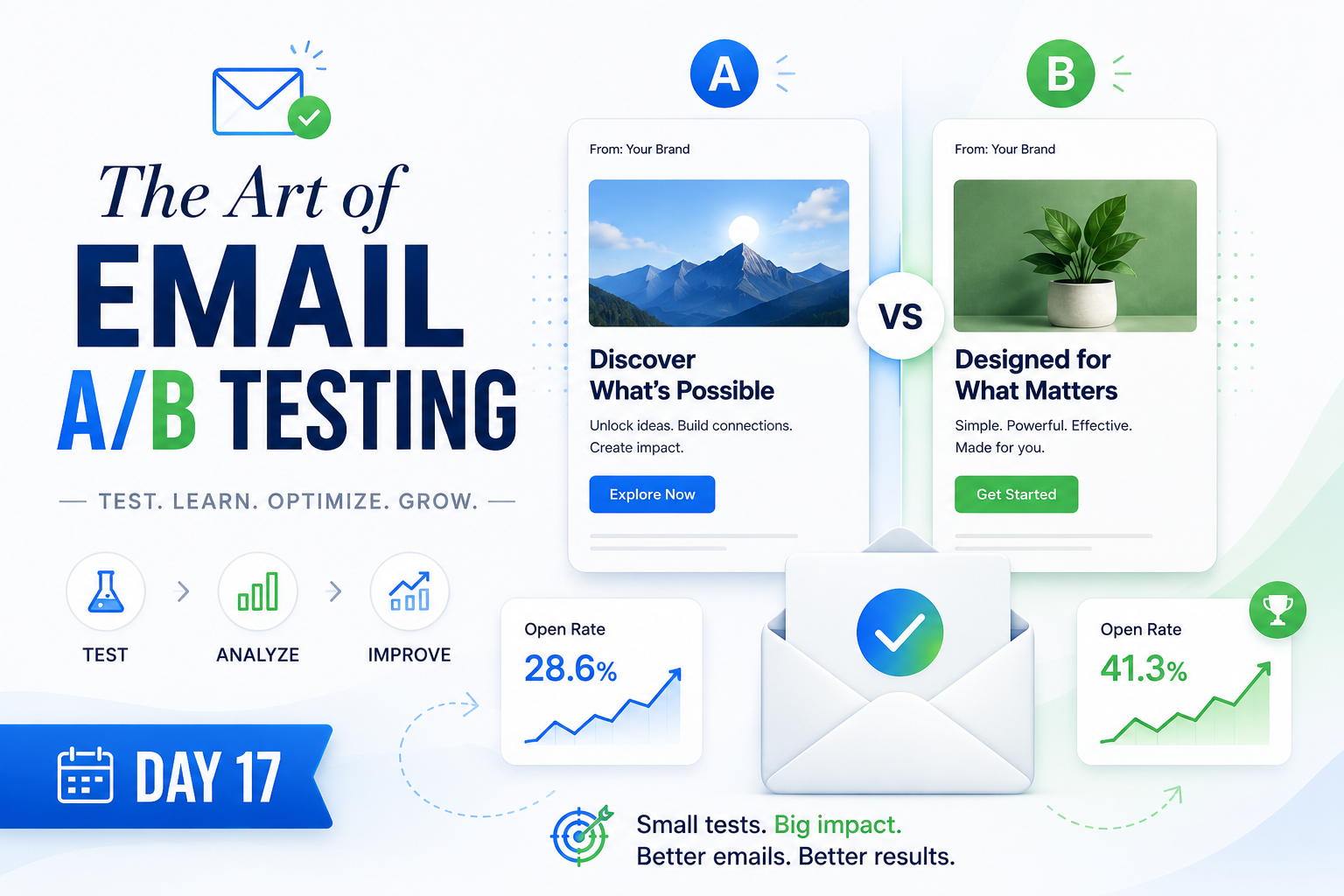





Did you know that companies utilizing systematic experimentation see a significant boost in conversion rates compared to those relying on intuition? Most digital marketers operate in the dark, hoping their messages resonate with the intended audience. However, the most successful brands treat every outreach campaign as a valuable learning opportunity.
This is where Email A/B Testing becomes your most powerful asset. By comparing two distinct versions of your content, you can identify exactly what drives your subscribers to click. This Email A/B Testing process removes the guesswork from your workflow, allowing you to refine your communication strategy with precision.
Adopting a data-driven mindset transforms your outreach from a simple chore into a precise science. When you master email a/b testing, you unlock the ability to generate measurable results that directly impact your bottom line. It is time to stop guessing and start optimizing for real growth.
Key Takeaways
- Systematic email a/b testing experimentation is a primary driver for modern digital marketing success.
- Data-driven email a/b testing decisions replace intuition to improve overall engagement rates.
- Refining your communication strategy leads to higher conversion and click-through performance.
- Transforming marketing efforts into a precise science yields consistent, measurable results.
- Continuous optimization ensures your outreach remains relevant to your target audience.
Still Guessing What Your Subscribers Want?
Stop relying on assumptions and start making smarter email decisions with data-backed testing strategies that boost opens, clicks, and conversions.
Foundations of Email A/B Testing
Success in digital marketing is rarely an accident; it is the result of disciplined, data-driven email a/b testing experimentation. Before you launch your next outreach effort, you must understand the core principles that govern Email A/B Testing. By building a solid framework, you ensure that your efforts lead to meaningful growth rather than guesswork.
Defining the Scope of Your Email A/B Testing Experiments
The most common mistake email a/b testing marketers make is testing too many variables at once. To gain clarity, you must define a narrow scope for every experiment. When you isolate a single element, such as a subject line or a call-to-action button, you can clearly identify what drives subscriber behavior.
Focusing your a/b testing for email campaigns on one specific change prevents data noise. This approach allows you to attribute performance shifts directly to your modifications. Always remember that simplicity is the ultimate sophistication in testing.
“If you cannot measure it, you cannot improve it.”
Establishing Statistical Significance
Reliability is the backbone of any successful email A/B testing program. You must ensure that your results are not merely the product of random chance. Statistical significance acts as your safeguard, confirming that the performance gap between your variations is genuine.
Without this mathematical rigor, you risk making decisions based on false positives. Always wait for a sufficient sample size before declaring a winner in your Email A/B Testing. This patience ensures that your future strategies are built on a foundation of truth.
Setting Clear Performance Benchmarks
Before you begin Email A/B testing, you need to know what success looks like for your brand. Establishing clear benchmarks provides a baseline for evaluating your a/b testing for email campaigns. Without these markers, you have no way to measure the true impact of your optimizations.
- Identify your current email a/b testing average open rates.
- Determine the minimum lift required to consider a test successful.
- Align your testing goals with broader business objectives.
By tracking these email a/b testing metrics consistently, you turn raw data into actionable insights. This disciplined approach to a/b testing for email campaigns will ultimately transform how you connect with your audience and drive long-term engagement.
Developing a Strategic Testing Framework
A strategic Email A/B testing framework acts as a roadmap for your email marketing efforts, ensuring every test serves a purpose. By moving away from guesswork, you create a consistent cycle of improvement that aligns with your broader business goals. This structured approach helps you maintain clarity throughout the entire subscriber lifecycle.

Formulating Hypotheses Based on Data
Every successful email a/b testing experiment begins with a clear, data-backed hypothesis. You should start by analyzing your current email a/b testing subscriber journey to identify specific pain points or areas where engagement drops off. Look closely at your metrics to see where users stop interacting with your content.
Once you identify a problem, draft a statement that predicts the outcome of a change. For example, you might hypothesize that adding a personalized greeting will increase click-through rates by five percent. This email a/b testing method ensures that your efforts are rooted in evidence rather than intuition.
Selecting Variables for Optimization Testing
When you begin optimization testing, it is tempting to change everything at once. However, isolating specific email a/b testing variables is the only way to understand what truly drives subscriber behavior. You should focus on one element per test to maintain the integrity of your results.
Common variables to consider include:
- Subject line length and tone
- Placement and color of your call-to-action buttons
- The visual hierarchy of your email layout
- Personalization tactics within the body copy
Prioritizing Tests for Maximum Impact
Not all email a/b testing are created equal, and your time is a limited resource. You must prioritize your optimization testing efforts to focus on the variables that offer the highest potential for conversion growth. A simple scoring system can help you rank experiments based on their expected impact and ease of implementation.
Focus your email a/b testing energy on high-traffic campaigns where even a small percentage increase can lead to significant revenue gains. By systematically addressing your biggest opportunities, you ensure that your marketing resources are always working toward your most important objectives.
Mastering Subject Line Variations
Every email you send begins with a single, critical decision: the subject line. This brief snippet of text determines whether your audience engages with your message or ignores it entirely. By prioritizing email marketing testing, you can uncover exactly what resonates with your specific subscribers.
What If One Subject Line Could Double Your Open Rates?
Learn what truly grabs attention, drives more clicks, and turns overlooked emails into high-performing campaigns with smarter A/B testing
Psychological Triggers in Email Marketing Testing
Email A/B testing human behavior is often driven by subconscious cues that influence our decision-making process. When you incorporate psychological triggers into your subject lines, you tap into these natural instincts to drive action.
- Urgency: Creating a sense of limited time encourages immediate clicks.
- Curiosity: Posing a question or hinting at a secret invites the reader to learn more.
- Social Proof: Mentioning popular trends or community feedback builds instant trust.
“The best subject lines are those that feel like a personal invitation rather than a sales pitch.”
Length and Formatting Considerations
The physical appearance of your subject line matters just as much as the words you choose. Because most users email a/b testing check their inboxes on mobile devices, you must keep your messaging concise and impactful.
Short subject lines often perform better because they are not truncated by mobile email clients. Aim for 30 to 50 characters to ensure your entire message is visible at a glance. Testing different lengths through email marketing testing will reveal the “sweet spot” for your unique audience.
Personalization Tactics for Higher Open Rates
Generic email a/b testing subject lines rarely capture attention in a crowded inbox. Modern email marketing testing allows you to experiment with advanced personalization beyond just using a first name.
Consider segmenting your list based on past purchase behavior or browsing history to tailor your subject lines. When a subscriber sees a reference to a product they recently viewed, the likelihood of an open increases significantly. Email a/b testing personalization transforms your outreach from a broadcast into a relevant, one-on-one conversation.
Optimizing Email Content and Design
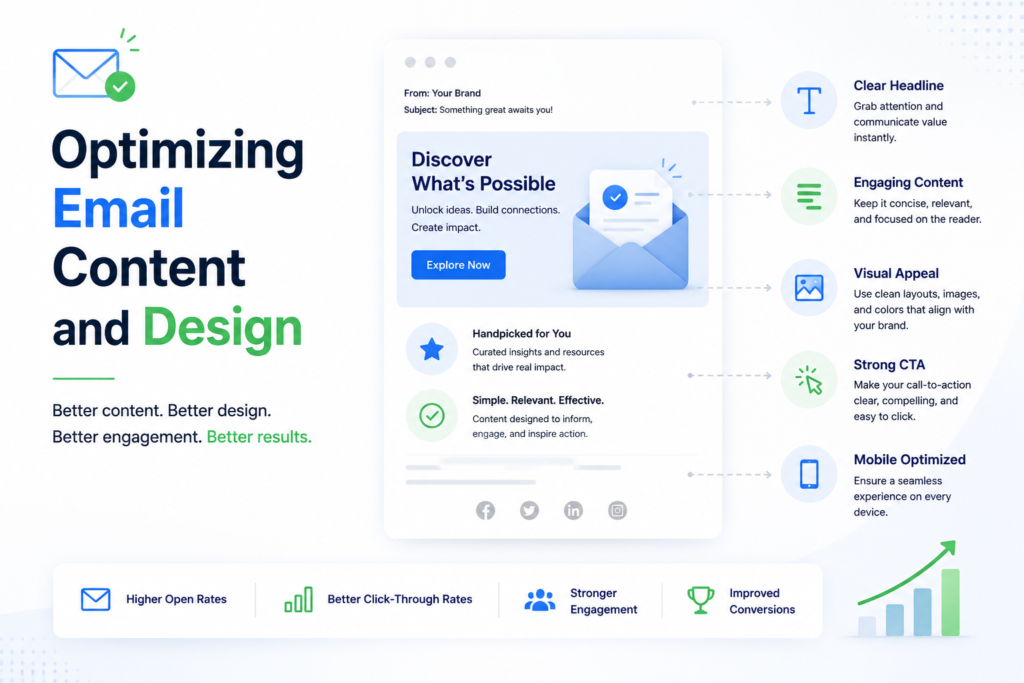
Your email design and content must work in perfect harmony to guide the reader toward your goals. Once a subscriber opens your message, the visual arrangement and the quality of your writing determine whether they click through or move on. Through rigorous optimization testing, you can identify which elements resonate most effectively with your audience.
Visual Hierarchy and Layout Experiments
The way you structure your email dictates how a reader processes information. Most users scan content in an F-pattern or Z-pattern, meaning your most critical information should occupy the top-left or center of the layout. You should experiment with single-column versus multi-column layouts to see which format improves readability.
Testing image placement is equally vital for maintaining interest. Placing a high-quality hero image at the top can capture attention, but it must not push your primary message below the fold. Always ensure that your layout remains clean and uncluttered to prevent overwhelming the reader.
Copywriting Styles and Tone Adjustments
Your brand voice should remain consistent, but the tone can shift based on the campaign goal. You might test a direct and urgent tone against a more conversational and storytelling approach to see which drives higher engagement. Short, punchy sentences often perform better for mobile users who prefer quick consumption.
Consider the impact of personalization beyond just the recipient’s name. Tailoring the body copy to reflect specific subscriber interests can significantly boost relevance. By conducting optimization testing on these stylistic variations, you gain clear insights into what language style triggers the best response from your unique list.
Call to Action Placement and Messaging
The call to action (CTA) serves as the bridge between interest and conversion. You should test the placement of your buttons, moving them from the middle of the email to the bottom to observe changes in click-through rates. A button that stands out through contrasting colors and clear, action-oriented text is essential for success.
The messaging within the button itself also requires careful consideration. Instead of generic phrases like “Click Here,” try using benefit-driven language such as “Get My Guide” or “Claim Your Discount.” The following table outlines key variables you should consider for your next round of testing.
| Variable | Option A | Option B | Goal |
|---|---|---|---|
| Layout | Single Column | Multi-Column | Readability |
| Tone | Professional | Conversational | Engagement |
| CTA Text | Generic | Benefit-Driven | Click-Through |
| Visuals | Hero Image | Minimalist | Focus |
By systematically applying optimization testing to these specific areas, you transform your email campaigns into high-performing assets. Remember to change only one variable at a time to ensure your results remain accurate and actionable. Consistent refinement leads to long-term growth in your marketing metrics.
Technical Execution of Email Split Testing
The success of your outreach efforts depends heavily on the technical rigor applied to your testing process. When you prioritize precision, you ensure that your data remains clean, reliable, and actionable for future growth. Mastering the mechanics of your experiments allows you to isolate variables and draw clear conclusions about subscriber preferences.
Segmenting Your Audience Effectively
To achieve valid results, you must divide your subscriber list into groups that accurately reflect your total audience. Randomization is the most critical factor in preventing bias during your experiments. By ensuring each group shares similar demographic and behavioral traits, you create a level playing field for your variations.
- Use random assignment to eliminate selection bias.
- Ensure group sizes are balanced to maintain statistical integrity.
- Exclude inactive subscribers to keep your data focused on engaged users.
Managing Sample Sizes for Reliable Results
Determining the right sample size is essential for achieving statistical significance in your split testing initiatives. If your sample is too small, you risk drawing conclusions from noise rather than actual trends. Conversely, testing with your entire list might be unnecessary if a smaller, representative subset provides the same level of confidence.
You should calculate your required sample size based on your current open rates and the expected improvement you hope to see. This approach ensures that your email split testing efforts yield results you can trust. Always aim for a sample large enough to detect meaningful differences between your test variations.
Tools and Platforms for Email Campaign Optimization
Selecting the right technology stack is a vital step in streamlining your workflow. Modern platforms offer built-in features that automate the distribution of variations and track performance metrics in real time. Leveraging these tools is key to effective email campaign optimization.
When evaluating potential software, look for platforms that offer:
- Automated winner selection based on pre-set goals.
- Advanced reporting dashboards for deep data analysis.
- Seamless integration with your existing CRM or marketing automation software.
By choosing a robust platform, you simplify the technical burden of email campaign optimization. This allows you to focus your energy on creative strategy and iterative improvements rather than manual data management.
Analyzing Email Test Metrics
Turning raw data into actionable insights is the hallmark of a successful email marketing strategy. When you engage in email a/b testing, the numbers you collect serve as a roadmap for future improvements. By carefully reviewing these results, you transform simple observations into a powerful engine for growth.
Interpreting Open and Click-Through Rates
Your open rate acts as the first indicator of how well your subject line resonates with your audience. A high open rate suggests that your messaging successfully captured attention in a crowded inbox. However, you must also look at your click-through rate to gauge the actual interest in your content.
These email test metrics provide a clear picture of engagement levels. If your open rates are high but clicks remain low, your internal content may not be delivering on the promise made by your subject line. Consistency between your hook and your call to action is vital for maintaining subscriber trust.
Evaluating Conversion and Revenue Data
While engagement is important, the ultimate goal of your campaigns is often tied to business outcomes. You should track how many clicks lead to a purchase or a sign-up on your landing page. This conversion data helps you calculate the true return on investment for your specific email variations.
Revenue tracking allows you to see which versions of your email drive the most value. By focusing on these financial indicators, you can justify your marketing spend and prioritize high-performing strategies. Always remember that a beautiful email is only successful if it effectively moves the needle for your business.
Identifying Patterns in Subscriber Behavior
Consistent email testing analysis reveals long-term trends that simple snapshots might miss. Over time, you will notice that certain segments of your audience respond better to specific tones, layouts, or offer types. Recognizing these patterns allows you to tailor your future communications to meet the unique needs of your subscribers.
You can organize your findings to better understand these preferences. Consider the following table to help categorize your observations:
| Metric Category | Primary Goal | Actionable Insight |
|---|---|---|
| Engagement | Build Interest | Refine subject lines |
| Conversion | Drive Revenue | Optimize CTA placement |
| Retention | Subscriber Loyalty | Adjust send frequency |
By documenting these behaviors, you create a knowledge base that guides your team. This proactive approach ensures that every campaign you send is smarter and more effective than the last.
Common Pitfalls in Email Variation Testing
Even the most seasoned digital marketers can encounter hidden obstacles that derail their optimization efforts. While email variation testing offers a clear path to higher engagement, the process is not without its risks. Recognizing these traps early is essential for maintaining the integrity of your data and the health of your subscriber list.

Avoiding Over-Testing and Subscriber Fatigue
One of the most frequent mistakes is bombarding your audience with too many experiments in a short timeframe. When you engage in constant split testing, your subscribers may eventually feel overwhelmed by the repetitive nature of your communications. This leads to increased unsubscribe rates and lower overall engagement.
To maintain a healthy cadence, prioritize quality over quantity. Ensure that your email marketing testing schedule allows for adequate rest periods between major campaigns. By respecting your audience’s inbox space, you keep them interested and receptive to your future messages.
Preventing Bias in Email Testing Analysis
Data integrity is the backbone of any successful campaign. A common error involves interpreting results through a lens of confirmation bias, where you only focus on metrics that support your initial hypothesis. Rigorous email testing analysis requires you to remain objective, even when the data contradicts your expectations.
Always ensure that your sample sizes are large enough to provide statistically significant results. If you draw conclusions from a small or skewed group, your findings will likely be unreliable. Objectivity is your best tool for turning raw numbers into actionable insights.
Managing Multiple Variables Simultaneously
It is tempting to change several elements at once to speed up the optimization process. However, testing too many variables at the same time makes it impossible to determine which specific change caused the shift in performance. This approach often leads to confusing results that provide little value for future strategy.
For the most accurate email split testing, focus on isolating one variable per experiment. Whether you are adjusting subject lines or call-to-action buttons, keeping your tests clean ensures that your email marketing testing remains precise. By mastering this disciplined approach, you avoid the common pitfalls that hinder long-term growth.
Scaling Your Email Marketing Success
Turning your email program into a high-performing engine depends on how well you capture and apply your past findings. Scaling your efforts requires a commitment to continuous learning and the systematic application of data. By moving beyond one-off experiments, you create a foundation for long-term growth and sustained revenue.
Documenting Insights for Future Campaigns
Every experiment you run provides valuable data that should not be lost. You must maintain a centralized repository to track your results, as this knowledge base is essential for future email campaign optimization. When you document what works and what fails, you avoid repeating past mistakes.
Consider organizing your findings into a structured format to ensure they remain actionable. You should track the following elements in your documentation:
- The specific hypothesis tested during your email variation testing.
- Key email test metrics that influenced the final decision.
- Contextual factors, such as the time of day or audience segment involved.
- Lessons learned regarding subscriber preferences and engagement patterns.
Iterative Improvement Cycles
Growth does not happen by accident; it occurs through consistent, iterative cycles. By refining your approach based on previous email test metrics, you ensure that every new campaign performs better than the last. This process of constant refinement is the hallmark of a mature marketing strategy.
You should view each campaign as a stepping stone toward greater efficiency. Even small adjustments to your layout or copy can lead to significant cumulative gains over time. Consistency is the key to unlocking the full potential of your subscriber list.
Integrating A/B Testing into Your Marketing Workflow
To achieve lasting success, you must make a/b testing for email campaigns a standard part of your daily routine. Rather than treating tests as special events, integrate them into your standard production schedule. This shift ensures that email campaign optimization becomes a natural habit rather than an afterthought.
By embedding email variation testing into your workflow, you empower your team to make data-driven decisions with confidence. This systematic approach reduces guesswork and allows you to focus on strategies that deliver measurable results. Ultimately, this integration leads to a more agile and responsive marketing operation.
Ready to Turn Every Email Into a Growth Opportunity?
Optimize subject lines, messaging, layouts, and CTAs with proven testing strategies designed to increase engagement and maximize campaign results.
Conclusion
Mastering the art of email a/b testing turns your marketing efforts into a precise science. You move past guesswork by relying on hard data to guide your creative choices. This disciplined approach ensures every message you send resonates deeply with your target audience.
Successful brands like Mailchimp and HubSpot prove that consistent testing drives long-term growth. You gain a competitive edge when you treat every campaign as a chance to learn and refine your tactics. Small adjustments often lead to significant improvements in your overall engagement metrics.
Commit to this cycle of iterative improvement to keep your content fresh and relevant. Your subscribers will appreciate the value you provide through personalized and optimized communication. Start your next email a/b testing experiment today to see how data-backed decisions elevate your brand performance.
FAQs
Why is email split testing considered essential for modern digital marketing success?
Email split testing allows you to move away from subjective guesswork and toward a data-driven strategy. By systematically comparing different versions of your messages, you can identify exactly what resonates with your audience, leading to higher engagement and a more predictable return on investment for your brand.
How can I ensure that my optimization testing results are statistically significant?
To achieve statistical significance, you must ensure your sample size is large enough to represent your overall audience. This prevents random chance from skewing your data. Professional platforms like HubSpot or Salesforce Marketing Cloud often include built-in calculators to help you determine when a result is reliable enough to declare a winning variation.
Which variables should I prioritize when starting email variation testing?
You should prioritize variables that have the highest potential for impact on your primary goals. Usually, this begins with subject line variations to improve open rates, followed by call-to-action (CTA) placement and copywriting styles to drive click-throughs. Focus on one variable at a time to maintain a clean email testing analysis.
How does email marketing testing help in overcoming subscriber fatigue?
Email marketing testing helps you stay in tune with your audience’s changing preferences. By constantly experimenting with new formats, tones, and visual hierarchies, you keep your content fresh and relevant. This iterative approach prevents your communication from becoming predictable or stale, which is a common cause of declining engagement.
What are the most critical email test metrics to track for campaign optimization?
While open and click-through rates provide immediate feedback on engagement, you should also focus on deep email test metrics such as conversion rates and revenue per email. Tracking these data points through tools like Google Analytics or Adobe Experience Cloud ensures that your email campaign optimization is aligned with your actual business growth.
How do I avoid common pitfalls during my email testing analysis?
The most common mistake is testing too many variables simultaneously, which makes it impossible to pinpoint what caused a change in performance. Additionally, you must avoid bias by ensuring your audience segments are randomly assigned. Maintaining a disciplined framework similar to the rigorous testing standards used by brands like Netflix, will ensure your insights are actionable and accurate.
What platforms are recommended for professional email campaign optimization?
For robust a/b testing for email campaigns, industry leaders often turn to Mailchimp for its user-friendly interface or Klaviyo for its advanced segmentation capabilities. For enterprise-level needs, Oracle Eloqua provides deep technical precision for managing complex, multi-variable experiments across massive subscriber bases.
How can I scale my success using an iterative optimization testing cycle?
Scaling requires a commitment to documenting every insight gained from your optimization testing. By building a centralized knowledge base of what works, you can integrate these findings into your standard marketing workflow. This ensures that every future campaign starts from a baseline of proven success, allowing for continuous, incremental growth over time.
How often should I run Email A/B Testing campaigns?
The ideal frequency depends on your campaign volume and audience size, but consistency matters more than speed. Instead of testing every email, focus on high-impact campaigns such as product launches, newsletters, or promotional sequences. Running regular email a/b testing on critical touchpoints helps you continuously improve performance while avoiding unnecessary complexity. A structured testing schedule ensures you gather meaningful insights without overwhelming your subscribers.
Can small businesses benefit from email a/b testing with limited subscribers?
Yes, even small businesses can see measurable improvements through email a/b testing. While larger lists may achieve faster statistical significance, smaller audiences can still uncover valuable insights by testing one element at a time, such as subject lines, send times, or CTA messaging. Over time, these incremental improvements can lead to stronger engagement, better conversions, and a more effective email marketing strategy without requiring enterprise-level resources.