
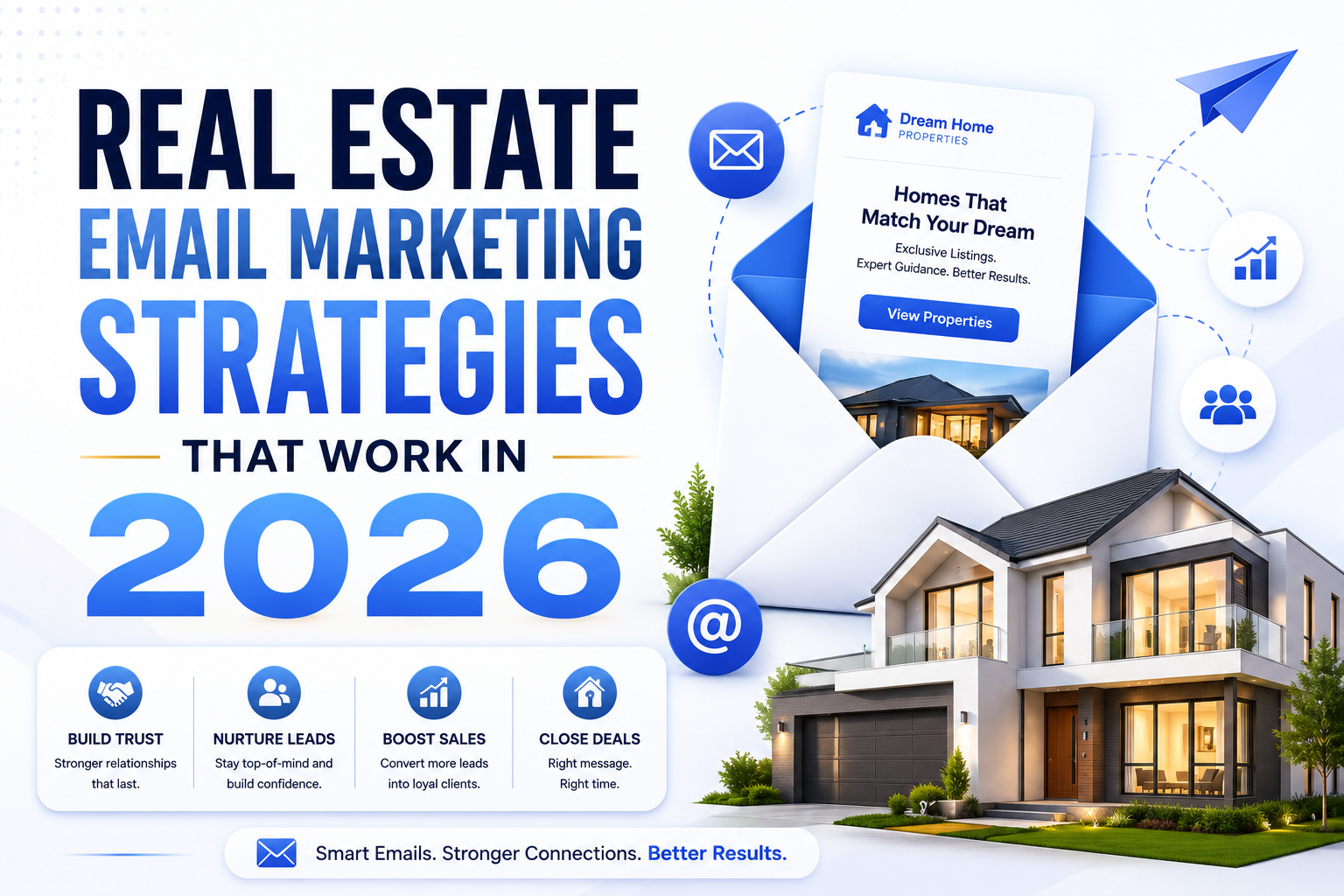


Did you know that over 90% of home buyers begin their search online, yet most professionals fail to capture these leads effectively? In today’s fast-paced United States housing market, your digital presence determines your success. You must adapt to changing consumer behaviors to stay ahead of the competition.

Developing a robust real estate email marketing and real estate email strategy is no longer optional. It is a necessity for long-term growth. By refining how you communicate through real estate email marketing, you can build lasting trust with potential clients. This approach ensures your brand remains top-of-mind when prospects are ready to make a move.
Mastering modern outreach allows you to nurture relationships automatically while providing genuine value. Implementing a refined real estate email marketing plan will help you convert casual browsers into loyal, repeat customers. Let’s explore the advanced tactics that will define your professional success this year.
Key Takeaways
- Digital engagement is critical for capturing modern property leads.
- A consistent communication plan builds long-term client trust.
- Personalization drives higher conversion rates in competitive markets.
- Automation tools save time while maintaining a professional touch.
- Strategic follow-ups ensure your brand stays relevant to buyers.
Stop Missing High-Intent Property Leads
Turn website visitors into serious buyers and sellers with smarter email follow-ups, automated nurturing, and personalized property updates.
The Current Landscape of Real Estate Email Marketing
Real estate email marketing has transformed from a basic notification tool into a high-stakes engagement platform. As we navigate through 2026, the digital environment demands more than just consistent posting; it requires a strategic approach to building long-term relationships. You must move beyond generic updates to capture the attention of busy, well-informed property seekers.
Why Email Remains the Top Channel for Property Professionals
Despite the rise of various social media platforms, email remains the most reliable way to reach your audience directly. Unlike social algorithms that can hide your content, your email list is an asset you fully own and control. This stability allows you to nurture leads through real estate email marketing over months or even years without the fear of sudden platform policy changes.
Effective email marketing for real estate agents provides a private space for meaningful dialogue. Real estate email marketing allows you to share detailed property insights, market reports, and personalized advice that social media feeds often bury. By maintaining this direct line of communication, you establish yourself as a trusted advisor rather than just another digital noise maker.
Adapting to Changing Consumer Expectations in 2026
Today’s clients expect hyper-personalized experiences from real estate email marketing that cater to their specific property goals. They are no longer satisfied with mass-market blasts that offer little value to their unique situation. To succeed, you must deliver content that is relevant, timely, and highly actionable.
The modern consumer values transparency and expertise above all else in real estate email marketing. They want to see data-driven insights that help them make informed decisions in a fluctuating market. Providing this level of value ensures that your emails are not just opened, but actively anticipated by your subscribers.
| Channel | Audience Control | Engagement Depth | Conversion Potential |
|---|---|---|---|
| High | High | Excellent | |
| Social Media | Low | Medium | Moderate |
| SMS | Medium | High | High |
By aligning your outreach with these evolving expectations, you position your brand for sustainable growth. Remember that every message you send is an opportunity to reinforce your professional reputation. Focus on quality, consistency, and genuine value to stay ahead in the competitive 2026 market.
Building and Segmenting Your Property Lead Database
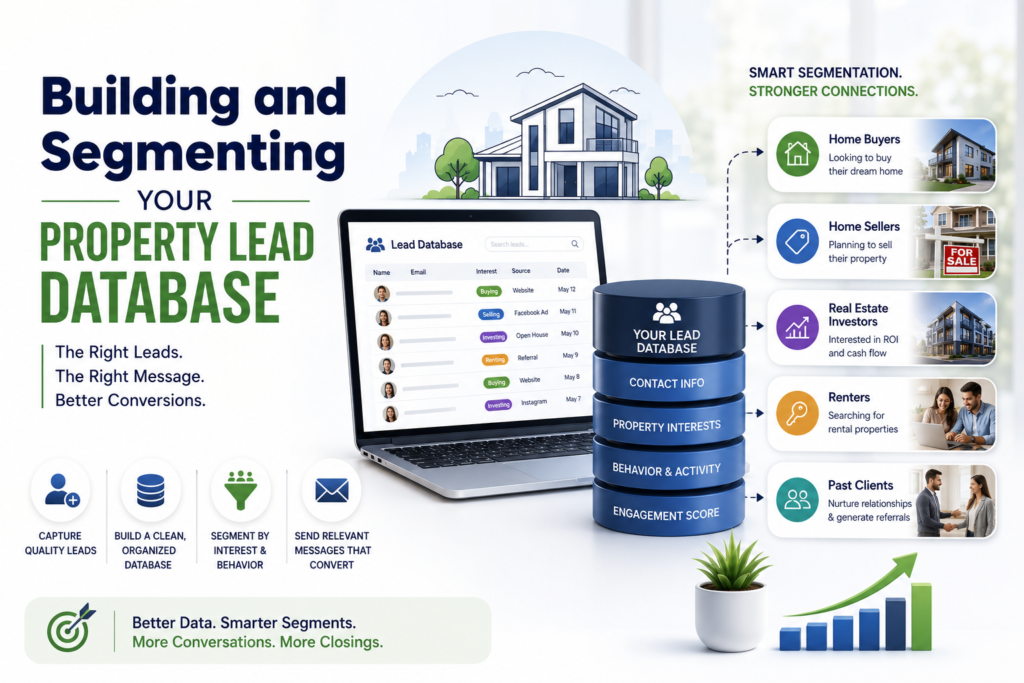
Your database is the engine that drives your entire real estate email marketing strategy. Without a clean and organized list, even the most creative messages will fail to reach the right audience. You must treat your contact list as a living asset that requires constant care and strategic growth.
Strategies for Growing Your Subscriber List Organically
Organic growth ensures that your subscribers are genuinely interested in your services for real estate email marketing. You can attract high-quality leads by offering valuable resources like neighborhood guides or market reports in exchange for an email address. Consistency is key in real estate email marketing when you implement these lead generation tactics across your website and social media channels.
in real estate email marketing, consider hosting virtual webinars or providing exclusive access to off-market listings. These real estate email ideas encourage prospects to join your list voluntarily. By focusing on value-driven content, you build trust before you even send your first formal property pitch.
Categorizing Leads by Buyer Intent and Property Interest
Once you have captured a lead in real estate email marketing, you must categorize them to ensure your messaging remains relevant. Sending a luxury condo listing to a first-time homebuyer looking for a suburban starter home is a quick way to lose a subscriber. You should segment your database based on specific criteria to improve your engagement rates.
- Buyer Intent: Separate active buyers from those just browsing or researching market trends.
- Property Type: Group leads by interest in single-family homes, townhouses, or investment properties.
- Geographic Focus: Target your updates based on specific neighborhoods or school districts.
| Segment Type | Primary Goal | Content Focus |
|---|---|---|
| Active Buyers | Schedule Showings | New Listings & Price Drops |
| Investors | ROI Analysis | Market Data & Rental Yields |
| First-Time Buyers | Education | Mortgage Tips & Area Guides |
Maintaining Data Hygiene for Better Deliverability
Data hygiene is the process of cleaning your list for real estate email marketing to remove inactive or invalid email addresses. If you ignore this, your bounce rates will climb, and internet service providers may flag your domain as spam. Regular maintenance protects your sender reputation and ensures your emails land in the primary inbox.
You should perform a deep clean of your database at least once every quarter. Remove subscribers who have not opened your emails in over six months. By keeping your list healthy, you ensure that your real estate email marketing efforts reach the people who are most likely to convert into clients.
Crafting High-Converting Real Estate Email Templates
High-converting real estate email templates serve as the backbone of real estate email marketing and your digital outreach strategy. When you master the art of communication, you significantly improve your results in email marketing for real estate agents. Every message you send should provide value while reflecting your unique brand identity.
Writing Subject Lines That Demand Attention
Your subject line is the gatekeeper of your message in real estate email marketing. If it fails to capture interest, the rest of your content remains unseen. To boost your open rates, focus on clarity and curiosity rather than aggressive sales tactics.
- Use personalization by including the recipient’s name or neighborhood.
- Keep subject lines under 50 characters to ensure they display fully on mobile devices.
- Create a sense of urgency or exclusivity regarding new property listings.
Balancing Visual Content with Text-Based Authenticity
A successful real estate email campaign requires a delicate balance between high-quality imagery and genuine, human-centered text. While professional property photos are essential, relying solely on images can trigger spam filters or appear impersonal. You should aim to weave your professional insights into the narrative of the email.
Authenticity builds trust in real estate email marketing, which is the currency of the real estate industry. Use images to showcase the property, but use your words to explain why that home fits the specific needs of your lead. This hybrid approach ensures your emails feel like a personal recommendation rather than a generic advertisement.
Structuring Emails for Mobile-First Readability
Most of your clients will view your emails in real estate email marketing on their smartphones while on the go. If your layout is cluttered or difficult to navigate, they will likely delete it within seconds. In real estate email marketing, you must prioritize a clean, single-column design that scales perfectly across all screen sizes.
Ensure your call-to-action buttons are large enough to be tapped easily with a thumb. Use short paragraphs and bullet points to break up dense information, making it easier for readers to scan your content quickly. By focusing on mobile-first readability, you provide a seamless experience that encourages higher engagement and faster response times.
Leveraging Real Estate Email Automation for Nurturing
Your ability to nurture leads in real estate email marketing effectively often depends on the sophistication of your digital workflows. By implementing real estate email automation, you remove the burden of manual tasks while ensuring every prospect receives timely, relevant information. This approach allows you to scale your outreach without sacrificing the personal touch that clients expect.
Ready to Put Your Real Estate Follow-Ups on Autopilot?
Save time, nurture leads automatically, and send the right property updates at exactly the right moment.
Setting Up Drip Campaigns for New Leads
A well-structured drip campaign in real estate email marketing acts as a digital concierge for your new subscribers. Instead of sending a single message, you can deliver a series of helpful emails that guide prospects through the buying process. These sequences provide immense value by sharing local market insights, home-buying checklists, and neighborhood guides.
When you design your real estate email campaign, focus on solving common pain points for first-time buyers. By providing answers through real estate email marketing before they even ask, you establish yourself as a trusted advisor. This consistent presence keeps your brand at the forefront of their minds during their research phase.
Automating Follow-Ups After Property Showings
Speed is critical in real estate email marketing when a potential buyer finishes a property tour. An automated follow-up email should trigger immediately after a showing to capture their feedback while the experience is fresh. This proactive step demonstrates your professionalism and commitment to their needs.
You can include a simple survey or a link to schedule a follow-up call within these messages. This strategy helps you identify high-intent leads who are ready to move forward. It also provides a structured way to gather insights on why a specific property might not have been the right fit.
Triggering Re-Engagement Sequences for Cold Leads
Not every lead in real estate email marketing is ready to purchase immediately, and that is perfectly normal. You can use automated sequences to warm up cold leads by sharing fresh real estate email ideas, such as recent price drops or exclusive market reports. These automated nudges can spark renewed interest without requiring you to manually track every inactive contact.
| Trigger Event | Primary Goal | Recommended Action |
|---|---|---|
| New Lead Signup | Build Trust | Send Welcome Series |
| Property Showing | Gather Feedback | Request Property Review |
| 60 Days Inactive | Re-engage | Share Market Update |
By maintaining a clean and active database, you ensure that your communication remains effective and relevant. Consistency is the key to long-term success in the competitive property market. With the right systems in place, you can focus your energy on closing deals rather than managing administrative tasks.
Advanced Personalization Tactics for 2026 in Real Estate Email Marketing
You can transform your outreach by adopting advanced personalization tactics that resonate with today’s buyers. In a crowded digital space, generic messages often fail to convert. By leveraging specific data points, you ensure that every interaction feels tailored to the individual recipient.
Using Behavioral Data to Tailor Property Recommendations
Your subscribers leave a digital footprint in real estate email marketing every time they click a link or view a listing. You should capture this behavioral data to refine your real estate email templates. When a lead spends time looking at luxury condos in downtown Chicago, your next email should feature similar properties rather than suburban single-family homes.
“Personalization is not just about using a first name; it is about providing value that aligns with the user’s current journey.”
Dynamic Content Blocks Based on Geographic Preferences
Dynamic content in real estate email marketing allows you to swap sections of an email based on the recipient’s location or interests. You no longer need to create separate campaigns for different neighborhoods. Instead, a single email can display local market updates or featured listings that automatically adjust to the reader’s specific geographic preferences.
This approach keeps your messaging relevant without increasing your workload. It ensures that a buyer in Miami sees different content than a buyer in Seattle, even if they are part of the same mailing list.
The Role of Artificial Intelligence in Predictive Messaging
Artificial intelligence has become a game-changer for real estate email automation. By analyzing historical patterns, AI tools can predict when a lead is most likely to be ready for a showing or a consultation. This allows you to send messages at the exact moment they are most impactful.
If you are looking for fresh real estate email ideas, consider using AI to trigger sequences based on predictive behavior. These systems identify subtle signals, such as increased site activity, to prompt a timely follow-up. Embracing these technologies helps you stay ahead of the competition while building deeper trust with your clients.
Choosing the Right Real Estate Email Software
Selecting the right technology for real estate email marketing is the foundation of a successful digital outreach plan. As you scale your business, the tools you choose will dictate how effectively you manage your client relationships. Finding the ideal real estate email software requires a clear understanding of your specific operational needs and long-term growth goals.
Key Features to Look for in CRM-Integrated Platforms
The most effective email marketing for real estate agents relies on seamless data synchronization. You should prioritize platforms that offer native integration with your Customer Relationship Management (CRM) system. This ensures that every lead interaction is tracked and updated in real-time without manual data entry.
Look for robust real estate email automation capabilities that allow you to trigger messages based on specific lead behaviors. Features like automated tagging, lead scoring, and custom field mapping are essential for maintaining a clean database. A platform that provides these tools will save you hours of administrative work each week.
Comparing Top Tools For Real Estate Email Marketing
Choosing between industry leaders often comes down to your specific business model and budget. While some tools excel at creative design, others are built specifically for high-volume lead conversion and sales tracking. The following table highlights the primary strengths of these popular platforms.
| Platform | Primary Strength | Best For | CRM Integration |
|---|---|---|---|
| Mailer Rocket | Email Automation & Bulk Outreach | Real Estate Agencies & Property Lead Nurturing | Excellent |
| Mailchimp | Design & Templates | Brand Awareness | Moderate |
| Constant Contact | Ease of Use | Small Agencies | Basic |
| Follow Up Boss | Lead Conversion | High-Volume Teams | Excellent |
Integrating Email Tools with Your Existing Tech Stack
Your email platform should never function as a siloed application. To maximize operational efficiency, you must connect your email tools with your broader tech stack, including your website, social media, and lead generation forms. Using middleware like Zapier can bridge the gap if a direct integration is not available.
Consistency is key when building your digital ecosystem. By ensuring that your real estate email software communicates perfectly with your other tools, you create a unified experience for your leads. This strategic approach allows you to focus on closing deals rather than managing technical hurdles.
Analyzing Performance Metrics to Refine Your Strategy
Transforming raw numbers into actionable insights is the key to scaling your business. By evaluating how your audience interacts with your outreach, you can build a more effective real estate email strategy that resonates with potential buyers and sellers.
Interpreting Open Rates and Click-Through Rates
Your open rate serves as the first indicator of whether your subject lines are compelling enough to capture interest. If your rates are low, consider testing different hooks or timing your sends to match when your leads are most active.
The click-through rate (CTR) reveals how many recipients found your content valuable enough to take action. A high CTR suggests that your call-to-action buttons and property links are perfectly aligned with the needs of your audience. Consistently monitoring these metrics allows you to pivot quickly when a specific real estate email campaign fails to meet expectations.
Tracking Conversion Metrics Beyond the Inbox
While engagement within the email is important, the ultimate goal is to drive traffic to your website or generate property inquiries. You should integrate your analytics to see if a click leads to a booked showing or a request for a market valuation.
Tracking these downstream actions helps you understand the true return on investment for your marketing efforts. If you notice that users click but do not convert, you may need to optimize your landing pages for a better user experience. Connecting your email data to your CRM ensures you never lose sight of the full customer journey.
A/B Testing Your Way to Higher Engagement
A/B testing is the most reliable way to remove guesswork from your marketing process. By sending two variations of an email to a small segment of your list, you can identify which version performs better before sending it to your entire database.
Most modern real estate email software includes built-in tools to automate these tests. You can experiment with different subject lines, imagery, or even the placement of your contact information. Small, incremental changes often lead to significant improvements in your overall engagement levels over time.
Compliance and Deliverability Best Practices
Protecting your agency from legal risks starts with understanding the rules governing digital communication. When you send messages to potential buyers or sellers, you must ensure that your outreach aligns with federal and international standards. Failing to do so can result in heavy fines and a damaged sender reputation that is difficult to repair.
Navigating CAN-SPAM and Global Privacy Regulations
In the United States, the CAN-SPAM Act sets the baseline for commercial messaging. You are required to provide a clear way for recipients to opt out of future communications and must include your physical business address in every email. Transparency is your best defense against regulatory scrutiny.
If you operate internationally or handle data from residents in regions like the European Union, you must also consider GDPR compliance. Even within the U.S., state-level laws like the CCPA in California emphasize the importance of explicit consent. Always ensure your real estate email templates include a visible link to your privacy policy to keep your operations transparent and secure.
Avoiding Common Triggers That Lead to Spam Folders
Your deliverability depends on how mailbox providers perceive your sender identity. Avoid using excessive capitalization, misleading subject lines, or an overwhelming number of links, as these are classic red flags for spam filters. High-quality content that provides genuine value to the reader is the most effective way to stay out of the junk folder.
Technical configuration is equally vital for your success. Ensure your domain is authenticated with SPF, DKIM, and DMARC records to prove your identity to receiving servers. Using reputable real estate email software helps automate these technical requirements, ensuring your messages reach the inbox consistently.
Managing Unsubscribe Requests and List Health
A healthy subscriber list is not defined by its size, but by the engagement of its members. You should make the unsubscribe process simple and immediate for any user who no longer wishes to receive your updates. Respecting these requests is not just a legal requirement; it is a professional courtesy that prevents your emails from being marked as spam.
Regularly scrub your database to remove inactive or bouncing email addresses. Maintaining a clean list improves your overall engagement metrics and signals to internet service providers that you are a responsible sender. By prioritizing list hygiene, you protect your ability to reach active leads who are genuinely interested in your property listings.
Turn More Property Leads Into Closed Deals
Build personalized email campaigns that keep buyers engaged, strengthen trust, and help convert prospects faster.
Conclusion
Success in the modern property market relies on your ability to connect with clients through real estate email marketing and meaningful digital interactions. A robust real estate email strategy serves as the foundation for these lasting professional relationships.
You now possess the tools to transform your communication from simple messages into high-value assets. By prioritizing personalization and automation, you create a seamless experience that keeps your agency top of mind for every potential buyer or seller.
Data-driven decisions allow you to refine your approach as market trends shift throughout 2026. Consistent application of these techniques turns your inbox into a powerful engine for lead generation and client retention.
View your real estate email strategy as a long-term investment in your brand reputation. Start implementing these practices today to see measurable growth in your property deals and overall business success.