





Have you ever experienced that sudden wave of panic the moment after you click send on a major campaign? Even seasoned professionals occasionally overlook a broken link or a faulty subject line that ruins their conversion rates. An email marketing checklist gives your team a repeatable way to catch these issues before they affect campaign performance.
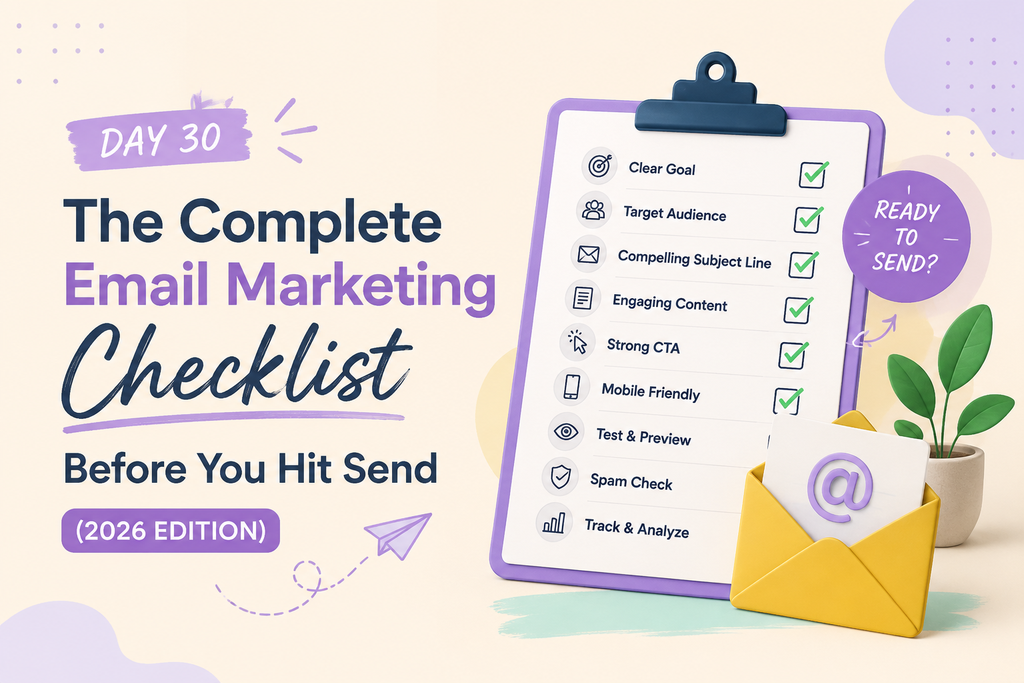
To avoid these costly mistakes, you need a reliable review system that covers every detail from design to deliverability. This guide provides a comprehensive email marketing checklist to ensure your messages reach the right inbox every time.
We will walk you through the entire process, starting from initial planning and moving toward post-send monitoring. By verifying your audience segments, conversion paths, and compliance settings, you can guarantee measurable business results. Following this professional workflow helps you maintain high engagement and keeps your brand reputation secure in 2026.
Key Takeaways
- Establish a consistent review process to prevent common technical errors.
- Verify all links and conversion paths before scheduling your broadcast.
- Prioritize deliverability by checking compliance and authentication settings.
- Use data-driven insights to refine your audience segmentation strategy.
- Monitor post-send analytics to improve future campaign performance.
Turn Every Email Into a Confident Launch
Turn every send into a confident launch with a structured email marketing checklist covering strategy, links, deliverability, testing, compliance, and post-send performance all in one.
Set the Campaign Goal, Audience, and Success Criteria
Defining your objectives early is the most effective way to ensure your email marketing checklist delivers real results. By establishing a clear decision-making framework before production begins, you eliminate guesswork and keep your team focused on the primary objective.
Define the single action you want subscribers to take
Every email should drive one specific behavior. Whether you want users to download a whitepaper, purchase a product, or register for a webinar, your call to action must be singular and unambiguous.
When you provide too many choices, you risk confusing your audience. A focused message ensures that your email campaign checklist remains streamlined and effective for the end user. As part of your email marketing checklist, make sure the primary CTA directly supports this single desired action.
Confirm the campaign matches the subscriber segment
Relevance is the cornerstone of high engagement. You must verify that the content you are sending aligns perfectly with the interests and behaviors of your chosen segment.
Sending a generic message to a highly specific group often leads to higher unsubscribe rates. Always review your list criteria to ensure the message resonates with the people receiving it. Adding audience relevance to your email marketing checklist helps prevent unnecessary unsubscribes and weak engagement.
Choose measurable goals and performance benchmarks
Success criteria should be established before you hit send so you can evaluate performance objectively. You need to know exactly what “success” looks like for every individual campaign. Use your email marketing checklist to document these goals before the campaign moves into production.
| Campaign Type | Primary Metric | Success Benchmark |
|---|---|---|
| Newsletter | Open Rate | 25% – 30% |
| Promotional | Click-Through Rate | 3% – 5% |
| Transactional | Conversion Rate | 10% – 15% |
Verify the send date, time, and time zone
Timing is often the difference between a high open rate and a buried message. You must confirm that your send schedule aligns with the peak activity hours of your target audience.
Double-check your time zone settings to avoid sending emails in the middle of the night. A well-timed delivery ensures your email marketing checklist concludes with a successful launch that reaches your subscribers when they are most likely to engage.
This timing check should always have a place in your email marketing checklist before scheduling the campaign.
Complete the Core Email Marketing Checklist
A successful email marketing campaign checklist starts with verifying that your message resonates with the subscriber’s current journey. When you align your content with the specific stage of the customer lifecycle, you increase the likelihood of meaningful engagement. This foundational step ensures that your communication feels relevant rather than intrusive.
Confirm the campaign type and subscriber journey stage
Identify whether your email is a welcome series, a promotional blast, or a re-engagement effort. Each type serves a distinct purpose in the subscriber journey. By mapping your content to the correct stage, you avoid sending irrelevant information that might lead to unsubscribes. Your email marketing checklist should confirm that the selected campaign type matches the subscriber’s current journey stage.
Match the message to the campaign objective
Every email must have a singular, clear goal. Whether you want to drive a sale or encourage a newsletter sign-up, your copy should focus entirely on that objective. If your message drifts, you risk confusing the reader and diluting your impact. Keeping this alignment in your email marketing checklist makes it easier to maintain a focused message from planning through execution.
Review the offer, value proposition, and primary benefit
Your subscribers need to understand exactly what they gain from clicking your link. Clearly state your value proposition and highlight the primary benefit immediately. A strong offer is the engine of your email marketing checklist, so ensure it is compelling and easy to find.
Remove unnecessary claims, distractions, and competing calls to action
Clutter is the enemy of conversion. If you include too many links or secondary offers, you distract the reader from your main goal. Strip away any text or imagery that does not directly support your primary call to action to keep the user focused. Include a distraction check in your email marketing checklist to keep the reader focused on the intended conversion.
Check that the email supports current promotions and business priorities
Finally, ensure your email aligns with your broader company strategy. An effective email marketing campaign checklist requires you to verify that your message does not conflict with other active promotions.
Consistency across all channels builds trust and reinforces your brand identity in the minds of your audience. This alignment makes the email marketing checklist a useful safeguard against conflicting messages and offers.
Review the Subject Line, Preheader, and Sender Details
Mastering the art of the subject line and sender identity is the foundation of a high-performing email campaign checklist. Before your message reaches the inbox, these elements act as the primary gatekeepers for your open rates. If these details are misaligned, even the most polished content will fail to reach its intended audience.
Write a clear subject line that reflects the email content
Your subject line must serve as an honest promise of what lies inside the email. Avoid clickbait tactics that mislead subscribers, as these often lead to high bounce rates and spam complaints. Instead, ensure the text accurately summarizes the value or information provided within the message body. Your email marketing checklist should also confirm that the subject line accurately represents the content subscribers will find inside.
Keep the subject line specific, readable, and compelling
Brevity is your best friend when crafting subject lines for mobile devices. Aim for clarity by front-loading the most important words to ensure they remain visible on smaller screens. A compelling subject line creates a sense of urgency or curiosity without resorting to excessive punctuation or all-caps. A thorough email marketing checklist should confirm that the subject line remains effective across different screen sizes.
“The subject line is the most important part of your email. If it doesn’t get opened, the rest of your hard work is invisible.”
Use the preheader to add context rather than repeat the subject line
The preheader text provides a secondary opportunity to entice your reader. Use this space to expand on your subject line rather than simply restating it. By providing additional context, you offer a more complete preview that encourages higher engagement. Making this a standard part of your email marketing checklist can help create a more useful and engaging inbox preview.
Confirm the sender name is recognizable to your subscribers
Trust is the currency of email marketing. Always use a sender name that your audience immediately recognizes, such as your brand name or a specific person from your team. Consistency in your sender identity helps build long-term brand recognition and improves deliverability. Include sender identity as a standard item in your email marketing checklist to maintain consistency across campaigns.
Verify the reply-to address and monitorable inbox
Never send an email from a “no-reply” address if you want to foster genuine relationships. Ensure your reply-to address is active and monitored by a team member who can respond to inquiries. This simple step turns a one-way broadcast into a meaningful conversation. Add this communication check to your email marketing checklist to ensure subscribers have a reliable way to respond.
Check personalization tokens and fallback text
Personalization tokens can significantly boost engagement, but they require careful testing. Always verify that your database contains the necessary information for every recipient. If a field is missing, ensure you have fallback text configured so the email remains professional and readable for everyone.
| Element | Best Practice | Common Pitfall |
|---|---|---|
| Subject Line | Clear and concise | Misleading clickbait |
| Preheader | Adds new context | Repeats subject line |
| Sender Name | Recognizable brand | Generic or unknown |
| Tokens | Includes fallback | Broken or empty fields |
By following this email campaign checklist, you ensure that every technical detail is optimized for success. Taking these extra minutes to review your inbox presentation will protect your sender reputation and improve your overall conversion rates.
Polish the Copy for Clarity, Accuracy, and Conversion
Refining your message is the most critical step in any professional email marketing checklist. Before you finalize your draft, ensure that every sentence serves a clear purpose in guiding your reader toward your objective.

Lead with the most important information
Subscribers often scan emails in seconds, so place your primary value proposition at the very top. By leading with the most compelling benefit, you capture attention immediately and reduce the risk of losing interest before the reader reaches your call to action. Your email marketing checklist should verify that the most important value proposition appears before secondary details.
Use concise paragraphs, descriptive subheads, and scannable formatting
Large blocks of text can overwhelm your audience and lead to higher bounce rates. Break your content into short, punchy paragraphs and use descriptive subheads to organize your thoughts. This scannable structure ensures that your message remains accessible on both desktop and mobile devices.
Make the tone consistent with your brand and audience
Your brand voice should remain stable across every communication channel. Whether your style is authoritative or conversational, consistency builds trust and helps your subscribers recognize your content instantly.
Replace vague language with clear, action-oriented wording
Avoid passive phrasing that leaves the reader guessing about the next step. Use strong, active verbs that encourage immediate engagement and provide a clear path forward for your audience.
Proofread grammar, spelling, punctuation, and capitalization
Errors in your copy can damage your professional reputation and distract from your offer. Always perform a final review to catch typos or awkward phrasing that might undermine your credibility. Including a final copy review in your email marketing checklist helps protect the credibility of every campaign.
Validate dates, prices, product names, discount codes, and expiration details
A successful email marketing campaign checklist requires meticulous attention to detail regarding your offer. Double-check that every price, product name, and discount code is accurate to prevent customer frustration and support issues.
Check personalization, dynamic content, and conditional messaging
If you use dynamic fields to personalize your emails, verify that the data pulls correctly for every segment. Test your conditional logic to ensure that subscribers see the content relevant to their specific journey stage or preferences.
Validate Every Call to Action and Link
Before you hit send, you must validate every path your subscriber takes after clicking a link. A professional email campaign checklist ensures that your audience reaches the intended destination without friction. If a link fails or leads to the wrong page, you lose a valuable conversion opportunity and damage your brand credibility.
Protect Your Conversions Before You Send
Catch broken links, unclear CTAs, rendering issues, and conversion blockers before they cost you results. Follow a proven review process and send confidently every time.
Make the primary call to action visible and specific
Your primary call to action (CTA) should stand out immediately. Use high-contrast colors and clear, action-oriented text that tells the user exactly what to expect. Avoid generic phrases like “Click Here” in favor of specific benefits like “Claim Your 20% Discount Now.” Your email marketing checklist should confirm that the CTA is easy to find and clearly communicates the next step.
Confirm each button and text link uses the intended destination
Every button and text link must point to the correct URL. Manually click through every element to ensure the destination matches the context of your message. Even a small typo in a URL can lead to a 404 error, which effectively kills your campaign performance.
Test links for redirects, tracking parameters, and broken pages
Verify that your redirects function correctly and do not create unnecessary delays. Check that your tracking parameters are appended properly to the end of your URLs. This step is vital for maintaining the integrity of your email campaign checklist and ensuring your analytics software captures every click.
Ensure landing pages reflect the email’s offer and wording
The landing page must provide a seamless transition from the email content. If your email promises a specific discount or product, the landing page should highlight that same offer immediately. Consistency in messaging builds trust and encourages the user to complete the desired action. Add landing-page consistency to your email marketing checklist so subscribers experience a seamless transition after clicking.
Verify coupon codes, forms, checkout flows, and account requirements
Test your checkout process from start to finish to ensure no technical barriers exist. If you offer a coupon code, verify that it applies correctly at the final stage of the purchase. Check that all forms are functional and that account requirements do not prevent new users from converting.
Review UTM parameters for accurate campaign attribution
Properly configured UTM parameters are essential for tracking the success of your marketing efforts. Ensure that your source, medium, and campaign tags are consistent with your internal naming conventions. This accuracy allows you to measure revenue attribution across your entire email campaign checklist. Add UTM validation to your email marketing checklist to ensure campaign data can be accurately analyzed after the send.
| Test Category | Action Required | Priority |
|---|---|---|
| Button Links | Verify destination URL | High |
| Coupon Codes | Test at checkout | High |
| UTM Tags | Validate tracking strings | Medium |
| Landing Page | Check offer alignment | High |
Check Layout, Branding, Images, and Accessibility
Visual consistency and accessibility are the pillars of a high-performing email marketing qa checklist. Your subscribers interact with your content across various devices, making it vital to ensure your design remains professional and functional in every environment.
Compare the email with your current visual brand standards
Your email must reflect your company identity immediately. Ensure that your logo, color palette, and typography align perfectly with your website and social media presence to build trust with your audience.
Confirm the hierarchy works without relying on visual effects
A strong design should guide the reader naturally through your message. Use clear spacing and font sizing to establish a logical flow that remains effective even if complex visual elements fail to load.
Test image dimensions, compression, alt text, and fallback behavior
Large images can slow down load times and frustrate users. Always compress your files and provide descriptive alt text so that your message is clear even if the images do not display correctly. Including image and accessibility checks in your email marketing checklist helps ensure the message remains useful when images fail to load.
Check fonts, colors, spacing, alignment, and mobile responsiveness
Most users will view your message on a smartphone. You must verify that your text is readable without zooming and that buttons are easy to tap on small touchscreens.
Ensure the email remains understandable when images are blocked
Many email clients block images by default to protect user privacy. Your email marketing campaign checklist should confirm that your copy is compelling enough to stand alone without visual support.
Use sufficient color contrast and descriptive link text
Accessibility is not just a technical requirement; it is a way to reach more people. Ensure your text stands out against the background and that your links describe exactly where the user will go.
Check heading order, screen-reader labels, and meaningful alt text
Screen readers rely on proper HTML structure to navigate your content. Use the following table to ensure your email meets basic accessibility standards:
| Element | Best Practice | Impact |
|---|---|---|
| Heading Tags | Use H1-H3 hierarchy | Improved navigation |
| Alt Text | Descriptive, not generic | Better inclusivity |
| Link Text | Action-oriented | Higher click rates |
- Verify that all fonts are web-safe or properly embedded.
- Test your layout on both iOS and Android devices.
- Confirm that your footer contains all required legal information.
Run the Email Marketing QA Checklist Across Devices
Implementing a robust email marketing qa checklist ensures that your message reaches your audience exactly as intended. By systematically reviewing your content, you protect your brand reputation and maximize engagement across diverse digital environments.
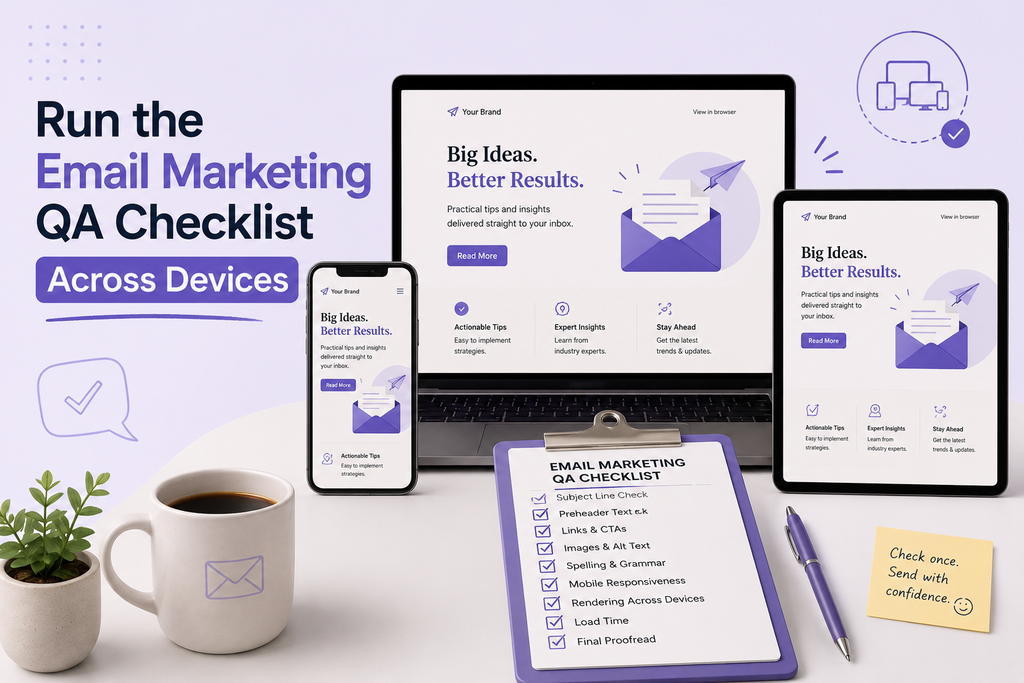
Send a controlled test email to internal reviewers
Before launching, send a live test version to a small group of internal stakeholders. This step allows you to catch errors that automated tools might miss, such as tone inconsistencies or broken logic in your messaging. Making test sends a standard part of your email marketing checklist helps your team identify issues before they reach the full audience.
Preview the campaign in desktop and mobile layouts
Your subscribers consume content on various screen sizes. You must verify that your layout remains clean and readable on both wide desktop monitors and compact smartphone screens.
Test rendering in Gmail, Outlook, Apple Mail, and Yahoo Mail
Different email clients interpret HTML code in unique ways. Ensure your design remains functional and visually appealing across these major platforms to avoid broken layouts.
Review the email on iOS and Android devices
Mobile users represent a significant portion of your audience. Testing on actual iOS and Android hardware helps you identify touch-target issues and font scaling problems that simulators might overlook.
Check dark mode, zoom, clipped content, and horizontal scrolling
Modern users often rely on dark mode, which can invert colors and hide text. Additionally, ensure your content does not force horizontal scrolling, as this creates a poor user experience. These device-specific checks should be documented in your email marketing checklist before the campaign receives final approval.
Compare the HTML version with the plain-text version
Some users or security filters will strip your HTML formatting. Always verify that your plain-text version is readable and contains all necessary links to maintain your email marketing checklist standards.
Use email preview tools to identify client-specific rendering issues
Leverage professional preview software to simulate how your email appears in dozens of environments. These tools are essential for catching edge cases in older versions of Outlook or niche webmail providers.
Record fixes and complete a final reviewer signoff
Maintain a log of all identified issues and the subsequent corrections. A formal signoff process prevents last-minute oversights and ensures accountability before the final send.
| Issue Type | Common Impact | Resolution Strategy |
|---|---|---|
| Dark Mode | Inverted text colors | Use transparent images |
| Clipped Content | Hidden CTA buttons | Keep code under 102KB |
| Mobile Scaling | Tiny font sizes | Set base font to 16px |
| Broken Links | Lost conversion data | Manual click-through test |
Protect Deliverability, Compliance, and Subscriber Trust
Your email campaign checklist must prioritize subscriber trust to ensure your messages reach the inbox. Maintaining a high sender reputation is essential for long-term success and requires strict adherence to industry standards.
Send only to permission-based, eligible subscribers
Always ensure that every recipient on your list has explicitly opted in to receive your communications. Sending unsolicited emails is the fastest way to damage your reputation and trigger spam filters.
Confirm the audience excludes unsubscribed, bounced, and suppressed contacts
A clean list is the foundation of a healthy email campaign checklist. You must scrub your database to remove inactive, bounced, or suppressed addresses before every deployment to maintain high engagement rates. List hygiene should remain a mandatory step in your email marketing checklist before every campaign deployment.
Review SPF, DKIM, and DMARC authentication status
Technical authentication proves to mailbox providers that you are a legitimate sender. Verify that your SPF, DKIM, and DMARC records are correctly configured to prevent unauthorized parties from spoofing your domain.
Check the sending domain, reply-to address, and domain alignment
Consistency across your sending domain and reply-to address builds credibility with your audience. Ensure that your domain alignment is accurate so that recipients recognize your brand immediately upon opening the message.
Include a working unsubscribe link and physical mailing address
Transparency is a legal and ethical requirement for professional marketers. Every email must contain a clear, functional unsubscribe link and your valid physical mailing address to remain compliant with global regulations.
Confirm the message complies with CAN-SPAM and applicable privacy requirements
Following the CAN-SPAM Act is non-negotiable for any email campaign checklist. You must ensure your content accurately represents your brand and provides a straightforward way for users to opt out of future contact.
Review spam-triggering language, excessive punctuation, and suspicious formatting
Avoid using aggressive sales language or excessive capitalization that might flag your email as spam. Keep your formatting clean and professional to ensure your message remains trustworthy and readable across all devices.
Confirm Segmentation, Automation, and Send Settings
Managing your automation and segmentation settings is the final hurdle in your email campaign checklist. Before you hit the send button, you must ensure that your technical configurations align with your strategic goals. Precision at this stage prevents common delivery errors and ensures your message reaches the intended audience.
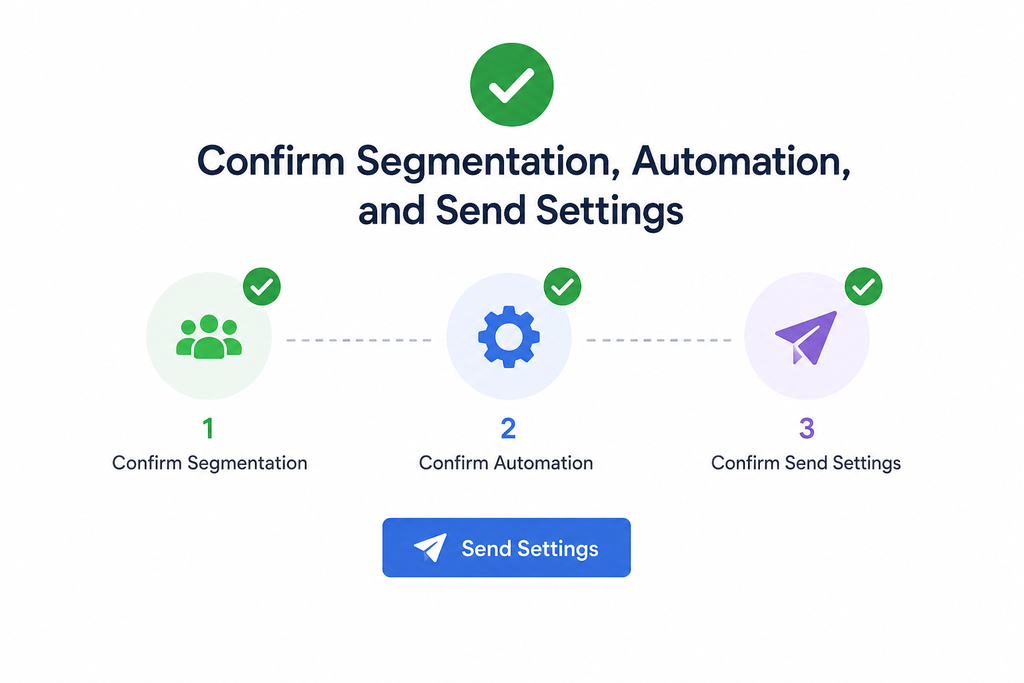
Verify the final recipient count and segment definition
Always double-check your final recipient count against your expected audience size. If the number seems unusually high or low, re-examine your segment filters to ensure they are active and accurate. A precise segment definition is the foundation of a successful outreach effort.
Check exclusions for recent purchasers, active support cases, and conflicting campaigns
You should proactively exclude subscribers who recently made a purchase or have an open support ticket. Sending promotional content to these individuals can create a negative brand experience. Additionally, verify that your current message does not conflict with other active automated sequences.
Review frequency limits and recent subscriber communication history
Check your platform’s frequency caps to avoid overwhelming your subscribers. Reviewing the recent communication history helps you maintain a healthy cadence. This step is a vital part of any professional email marketing campaign checklist to prevent list fatigue.
Confirm automation triggers, delays, branches, and exit conditions
Automation logic requires careful validation to ensure the customer journey flows as intended. Test your triggers, time delays, and branching paths to confirm they function under various scenarios. Always verify that your exit conditions are set correctly so subscribers leave the sequence once they complete the desired action. Adding automation validation to your email marketing checklist reduces the risk of subscribers entering the wrong journey or receiving conflicting messages.
Set the correct sender, reply-to address, and sending domain
Ensure your sender name is recognizable and consistent with your brand identity. Verify that the reply-to address is monitored by a human who can respond to customer inquiries. Confirming your sending domain alignment is also critical for maintaining high deliverability rates.
Choose the correct send time, time zone, and scheduling option
Select a delivery time that aligns with your audience’s peak activity periods. Always verify the time zone settings to avoid sending messages at inappropriate hours. Proper scheduling ensures your content arrives when your subscribers are most likely to engage.
Verify A/B test variables, audience splits, and winning-version rules
If you are running an A/B test, confirm that your variables are isolated and measurable. Check that your audience split is statistically significant and that your winning-version rules are clearly defined. This ensures your data remains clean and actionable.
| Configuration Task | Priority Level | Action Required |
|---|---|---|
| Segment Filtering | High | Validate criteria |
| Exclusion Lists | High | Remove recent buyers |
| Automation Logic | Critical | Test trigger paths |
| Send Scheduling | Medium | Verify time zone |
Finish the Email Campaign Checklist Before Scheduling
Treat this final review as the ultimate gatekeeper for your email marketing success. By implementing a rigorous email marketing checklist, you ensure that every detail aligns with your strategic objectives before the message reaches your subscribers.
Compare the final proof with the approved campaign brief
Review your final proof against the original campaign brief to ensure total alignment. Verify that the core message, offer, and value proposition remain consistent with your initial goals.
Confirm the correct email version, list, segment, and template
Double-check that you have selected the intended audience segment and the most recent version of your template. Sending the wrong content to the wrong list is a common error that this email campaign checklist helps you avoid.
Recheck the subject line, preheader, sender details, and primary CTA
Confirm that your subject line and preheader are error-free and compelling. Ensure the sender name is recognizable and that your primary call to action stands out clearly.
Open every link and complete the key conversion path
Manually click every link to verify that they lead to the correct landing pages. Complete the entire conversion path to ensure that forms, checkout flows, and account requirements function as expected.
Review tracking, analytics goals, and revenue attribution settings
Validate that your tracking parameters are active and correctly configured. Accurate data collection is essential for measuring the success of your efforts.
Save the final HTML, copy, audience criteria, and approval record
Maintain a comprehensive archive of your work. Saving the final HTML, copy, and audience criteria provides a valuable reference for future campaigns and internal audits.
Use a two-person approval process for high-impact campaigns
For major launches, implement a mandatory email marketing qa checklist review by a second team member. A fresh pair of eyes often catches subtle mistakes that the original creator might overlook.
Pause the send when a critical error remains unresolved
A clear email marketing checklist can help ensure that every element of the message supports this action.
Monitor Results After the Email Goes Live
Launching your email is only the beginning of a data-driven journey toward better engagement. While your email marketing checklist helps ensure a smooth deployment, the post-send phase provides the insights necessary to refine your strategy. You must remain vigilant to ensure your messages reach the intended audience and resonate effectively.
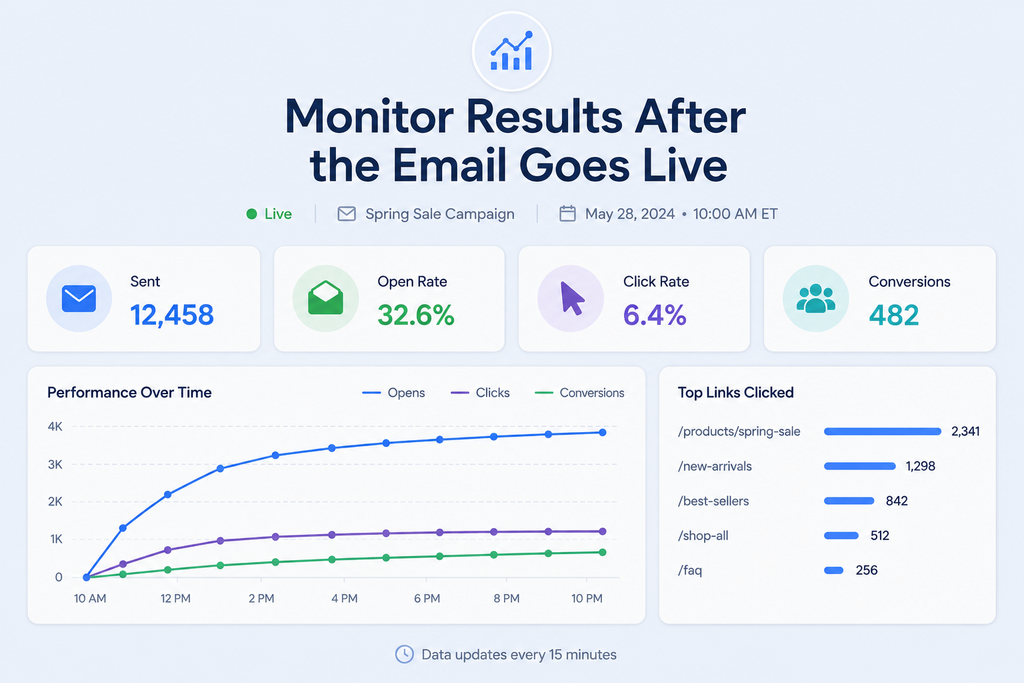
Watch delivery, bounce, complaint, and unsubscribe signals
The first step in post-send monitoring involves checking your delivery reports. High bounce rates or sudden spikes in spam complaints can indicate issues with your list hygiene or sender reputation. Always keep a close eye on your unsubscribe rate to see if specific content triggers subscriber fatigue.
Track opens, clicks, conversions, revenue, and engagement quality
Beyond basic delivery, you should analyze how users interact with your content. Tracking metrics like click-through rates and total conversions helps you understand the true value of your message. Revenue attribution is particularly important if your goal is to drive direct sales through your email efforts. Including post-send measurement in your email marketing checklist ensures that campaign results inform future improvements.
Compare results with the campaign’s original success criteria
Every campaign should be measured against the benchmarks you established during the planning phase. If your goal was to increase website traffic, compare your actual click volume against your initial projections.
This comparison highlights whether your current email marketing campaign checklist is aligned with your broader business objectives. This comparison allows your email marketing checklist to evolve based on actual campaign performance and audience behavior.
Investigate unusual performance changes before sending a follow-up
If you notice a sudden drop in engagement or an unexpected surge in bounces, pause your next scheduled send. Investigating these anomalies prevents you from damaging your sender reputation further. It is better to delay a follow-up than to send a message that might be flagged by spam filters.
Document lessons for future email marketing campaign checklists
Finally, take the time to record what worked and what failed. Maintaining a log of your campaign performance allows you to optimize your future strategy. By updating your email marketing checklist with these findings, you ensure that every subsequent send is more effective than the last.
| Metric Category | Primary KPI | Action Required |
|---|---|---|
| Deliverability | Bounce Rate | Clean inactive list |
| Engagement | Click-Through Rate | Refine CTA placement |
| Conversion | Revenue per Email | Optimize landing page |
| Retention | Unsubscribe Rate | Adjust send frequency |
Make Every Campaign More Reliable
Make your pre-send review more reliable by checking audience settings, authentication, personalization, conversion paths, and campaign performance before every send for consistent growth and engagement.
Conclusion
Executing a successful campaign requires more than just hitting send. A comprehensive email marketing checklist serves as the bridge between your creative vision and measurable business results. By aligning your strategy, copy, design, and technical requirements, you ensure every message reaches the right inbox with impact.
Your commitment to this process protects your sender reputation and builds lasting trust with your audience. Verifying your conversion paths, rendering across devices, and authentication protocols transforms your workflow into a reliable system. This rigorous approach minimizes errors while maximizing the value of every subscriber interaction.
Consistent use of an email marketing checklist creates a predictable rhythm for your team. It provides the documentation needed to refine your tactics and improve performance over time. When you prioritize these pre-send and post-send reviews, you gain clear insights that drive smarter decisions for your brand. Use these standards to turn every campaign into a consistent driver of growth and engagement.
FAQs
Why is it essential to use a comprehensive email marketing checklist for every campaign?
A professional email marketing checklist acts as a fail-safe to ensure your content, links, and design align with your strategic goals. By systematically reviewing every element from subject lines to deliverability settings, you protect your brand reputation, maximize subscriber engagement, and ensure your message reaches the inbox of platforms like Gmail and Outlook without technical errors.
What are the most critical items to include in an email campaign checklist regarding links?
Your email campaign checklist must prioritize the validation of every call to action. This includes testing all buttons and text links for redirects, ensuring UTM parameters are correctly set for tracking in Google Analytics, and verifying that landing pages reflect the specific offer mentioned in the copy. You should also test coupon codes and checkout flows on platforms like Shopify to ensure a seamless conversion path.
How does an email marketing QA checklist help with mobile and dark mode rendering?
An email marketing qa checklist requires you to test your layout across multiple devices and email clients using tools like Litmus or Email on Acid. This process identifies issues with mobile responsiveness, image clipping, or unreadable text in dark mode. By reviewing your campaign on both iOS and Android, you ensure that your visual hierarchy remains effective even when images are blocked or screen sizes change.
What compliance and deliverability steps should be part of a standard email marketing campaign checklist?
To maintain high deliverability, your email marketing campaign checklist should confirm that you are sending only to permission-based, eligible segments. You must verify your SPF, DKIM, and DMARC authentication status and ensure the inclusion of a working unsubscribe link and a physical mailing address to remain compliant with CAN-SPAM and GDPR regulations. Additionally, you should check for spam-triggering language that could cause Yahoo Mail or Apple Mail filters to flag your message.
How should I verify personalization and dynamic content before scheduling a send?
When utilizing an email marketing checklist, always send a controlled test email to internal reviewers to check personalization tokens and conditional logic. Ensure that fallback text is in place so that if a data field\ such as a first name or past purchase is missing in your Salesforce Marketing Cloud or HubSpot database, the subscriber sees a natural, professional greeting rather than a broken tag or an empty space.
Why is a post-send review just as important as the pre-send email campaign checklist?
Monitoring your results after the campaign goes live allows you to track delivery rates, bounces, and engagement quality against your original success criteria. By documenting these post-send signals, you can identify unusual performance shifts and refine your future email campaign checklist to better serve your audience and improve your overall return on investment.